July 2, 2026

A practical guide to getting your business cited in ChatGPT and Google AI Overviews: answer real customer questions, publish quotable content, and build clear authority.

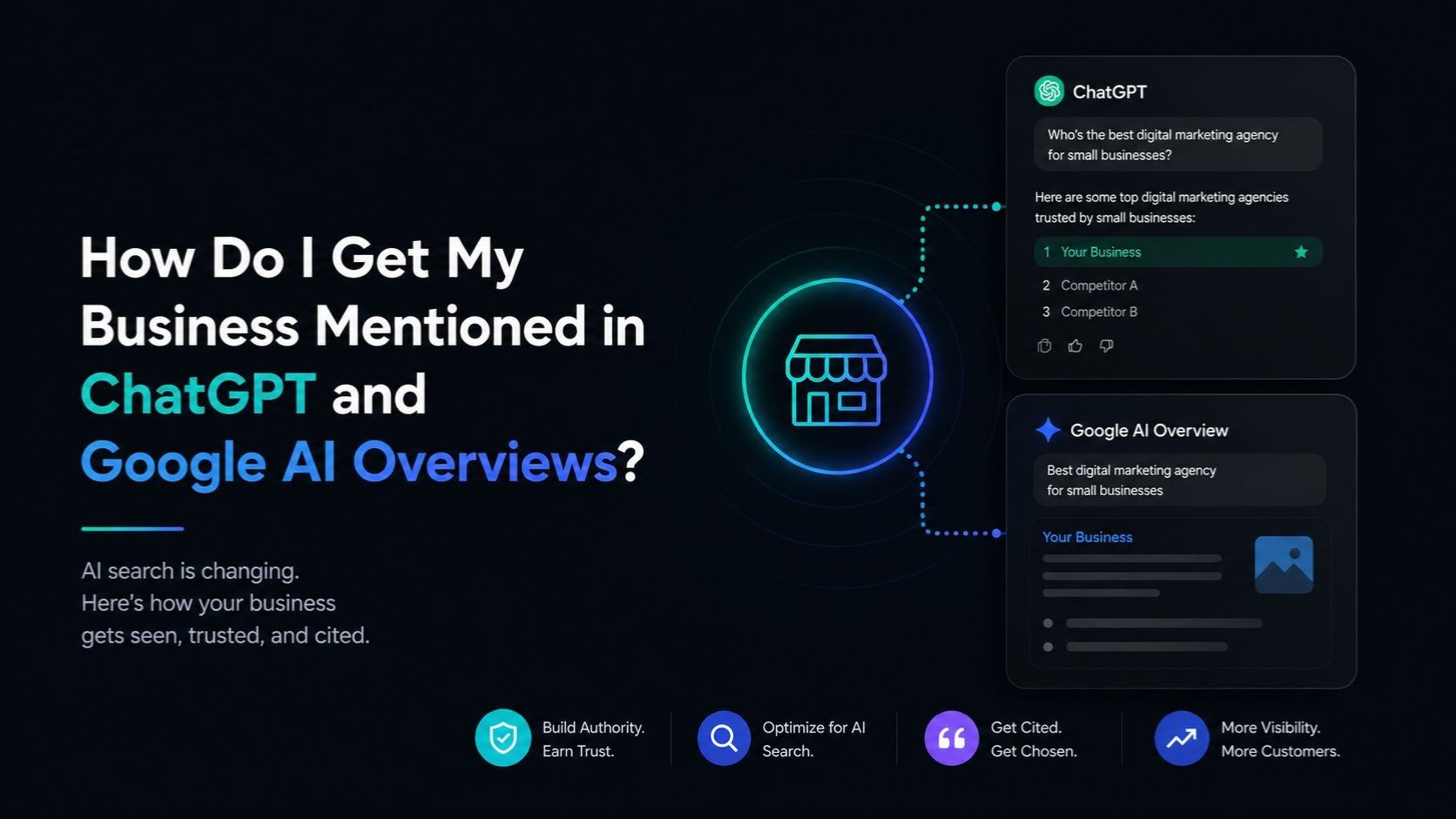
This is the question every business owner is starting to ask, and for good reason. When ChatGPT or a Google AI Overview names a business in its answer, that business gets the kind of visibility a page-one ranking used to deliver. Sometimes better, because there are only two or three names in the answer instead of ten links on a page.
So how do you become one of those names? There's no secret hack. But there is a clear principle, and most of your competitors aren't following it yet.
AI tools are answer engines. When someone asks a question, the AI scans for sources that answer it clearly, completely, and credibly. The businesses that get cited are the ones whose content does that job better than anyone else's.
This sounds obvious. It isn't. Most small business websites describe what the business does in the business's own words. Very few answer the questions customers ask in the customers' words.
Think about what people in your market are typing into ChatGPT right now. Not "kitchen remodeling services." They're asking "how much does a kitchen remodel cost in Orange County" and "do I need a permit to move a wall" and "how long will my kitchen be unusable during a remodel." If your website answers those questions directly, you've given the AI something to quote. If it doesn't, you haven't.
Here's the part that separates the businesses that win at this from the ones that don't. To answer customer questions well, you have to know your customers and your industry at a depth most marketing never reaches.
What do they worry about before they call you? What do they get wrong about your service? What does the buying process actually look like from their side? What context do they need that nobody in your industry bothers to explain?
When you can answer transparently, with the nuance and honesty that's rarely available online, you become the source AI tools reach for. You're publishing knowledge your competitors either don't have or won't share.
1. Keep your SEO foundation solid. AI Overviews and ChatGPT's web search both pull heavily from pages that already perform well in traditional search. Clean site structure, fast pages, proper headings, and a complete Google Business Profile are still the entry ticket.
2. Publish consistent, quotable knowledge. Write content that answers one real question per page, in plain language, with specific detail. Use the question as the heading. Answer it in the first paragraph, then expand. This format makes it easy for an AI to lift your answer and cite you as the source. A blog you update consistently builds this library over time.
3. Make everything simple to understand. AI systems reward clarity. If a smart stranger could read your page and immediately explain who you serve, what you do, where you do it, and why you're credible, an AI can too. If your page is vague, the AI moves on.
This is a compounding strategy, not an overnight one. Every clear answer you publish is another opportunity to be cited, and the citations build on each other as your authority grows. The businesses we've seen show up in AI answers got there by stacking dozens of genuinely useful pages, not by gaming anything.
If you're new to this whole category, start with our plain-English breakdown of what AI search optimization is. And if you'd rather not figure out the question list, the content plan, and the technical setup on your own, this is the work we do for local businesses every day through our AI search optimization service. Reach out and we'll map out what your customers are asking and where your gaps are.